
CHAMAEROPS HUMILLIS GROUP
¿WHAT IS A CHAMAROPS HUMILLIS?
Chamaerops humilis, known as the European fan palm, is a shrub-like palm belonging to the Arecaceae family. It is the only palm species native to the European continent specifically the Iberian Peninsula and the Balearic Islands and typically reaches a height of 1 to 4 meters. It can feature multiple trunks rising from the base, creating striking, attractive clusters. Its stiff, fan-shaped fronds are deep green or grayish, and the stems are often spiny; the plant produces fleshy fruits known as "fox dates."
¿WHAT IS A CHAMAEROPS HUMILLIS USED FOR?
It is one of the most widely used low-growing palms, valued for low-maintenance landscaping due to its high drought tolerance, its ability to protect soil from erosion in arid and coastal areas, and its function as a thorny physical barrier. It is frequently used to create impenetrable hedges and rock gardens, and to adorn terraces or gardens in Mediterranean regions that require minimal irrigation. Historically, it has also been widely used for weaving mats and making baskets, brooms, and ropes, as well as for upholstery stuffing.
¿WHAT CLIMATES DOES A CHAMAEROPS HUMILLIS RESIST?
Chamaerops humilis is an ideal choice because it is well-suited to the Mediterranean climate, adapting to both coastal and dry environments. It is extremely hardy, tolerating adverse conditions such as prolonged drought and poor soil, and withstands strong sea winds. It can endure frosts down to -10°C or even -12°C for short periods, and withstands very hot summers reaching 40°C or even 50°C occasionally provided it receives adequate watering.
¿WHERE CAN I PLANT A CHAMAEROPS HUMILLIS?
It can be planted in full sun in a pot, in mesh, or in sandy or rocky soil with good drainage as it does not tolerate waterlogging.
?WHAT IS THE MAINTENANCE FOR A CHAMAEROPS HUMILLIS?
Water once or twice a week in summer; in winter, water sparingly, avoiding waterlogging. Remove dried fronds to prevent pests or infections.
YUCCA ELEPHANTIPES EXEMPLARY
¿WHAT IS A YUCCA ELEPHANTIPES?
It is a succulent shrub native to Central America, characterized by a thick, woody base resembling an elephant's foot and by long, evergreen, spineless leaves that taper to a point. It can reach a height of 8 to 10 meters and typically produces large clusters of white or cream-colored flowers known as "flor de izote."
¿WHAT IS YUCCA ELEPHANTIPES USED FOR?
It is highly prized in gardening and landscaping for its decorative appeal and its great resilience to both cold and warm climates. It is ideal for well-lit interiors or low-water gardens, and its striking architectural appearance makes it a signature feature of Mediterranean gardens.
WHAT CLIMATES CAN YUCCA ELEPHANTIPES WITHSTAND?
It tolerates heat between 38ºC and 42ºC provided it is well-hydrated, though ideally, it should be kept in cool areas between 15ºC and 25ºC. Outdoors, it tolerates mild cold and can withstand occasional frosts down to -1ºC. It is resistant to drought and hot spells.
¿WHERE CAN I PLANT YUCCA ELEPHANTIPES?
In sandy, well-draining soil; in locations with plenty of light. If kept in partial shade, its growth will be slower, and its leaves weaker and yellowish.
¿WHAT IS THE MAINTENANCE FOR A YUCCA ELEPHANTIPES?
It requires watering once every 10–15 days in summer and once a month in winter. Excess water is the leading cause of death for the yucca, as it causes the roots to rot. Sparse watering and high exposure to sunlight are the keys to its care. It is a low-maintenance plant.


LIVISTONIA DECIPENS
¿WHAT IS A LIVISTONIA DECIPIENS?
Livistonia decipiens also known as Livistonia decora is a palm tree native to eastern Australia. It is highly prized in landscaping for the elegance of its long, fan-shaped leaves and drooping leaflets, which give it a weeping appearance, as well as for its slender, striking trunk. They typically reach a height of 10 to 15 meters.
¿WHAT IS A LIVISTONIA DECIPIENS FOR?
It is a species that can add height, lightness, and dynamism to tropical or contemporary gardens and landscapes featuring unique, minimalist designs. Thanks to its straight trunk and elegant, distinctive appearance, it is commonly used to line entrances, pathways, and promenades, as well as in public spaces and coastal areas such as urban parks or green zones along the Mediterranean coast.
¿WHAT CLIMATE DOES A LIVISTONIA DECIPIENS RESIST?
It is a palm tree resistant to wind, soil salinity, and hot climates, making it highly suitable for urban parks, gardens, or coastal areas along the Mediterranean and Atlantic. It withstands extreme temperatures of up to 45°C and frosts down to -4°C in mature specimens.
¿WHERE CAN I PLANT A LIVISTONIA DECIPIENS?
It can be planted in full sun or partial shade. Growth is more vigorous and rapid in well-lit areas. It adapts well to dry garden conditions with supplemental watering, as well as to loose, sandy soils with good drainage and low moisture levels.
¿WHAT IS THE MAINTENANCE FOR A LIVISTONIA DECIPIENS?
It requires infrequent watering, as it needs little water; however, during its growth phase, it benefits from regular watering without becoming waterlogged. It should be pruned once a year in the spring or before the onset of extreme heat once the leaves or fronds have fully drooped and dried out or withered.
TRACHYCARPUS FORTUNEI
¿WHAT IS A TRACHYCARPUS FORTUNEI?
Known as the windmill palm or Chinese fan palm, this is a perennial palm native to Asia. It is slow-growing. It typically features a single, slender trunk covered in coarse, dark brown fibrous material and can reach a height of 10 to 12 meters, bearing large, striking green, fan-shaped leaves under optimal conditions. It generally produces clusters of yellow flowers alongside small, inedible dark blue or black fruits.
¿WHAT IS TRACHYCARPUS FORTUNEI USED FOR?
It serves primarily as an ornamental plant in urban landscaping, gardens, and parks across Northern Europe; however, it is very common in public squares and on boulevards due to its exotic appearance, low maintenance requirements, resistance to pollution, and non-invasive root system.
¿WHAT CLIMATES CAN TRACHYCARPUS FORTUNE WITHSTAND?
It withstands extreme temperatures as low as -15°C or -20°C, as well as snow and frost, given that its natural range extends to altitudes of up to 2,400 meters. It can endure prolonged snowfall and frost provided the plant is well-established and the soil drains well. It handles direct sunlight very well, withstands temperatures exceeding 40°C, and tolerates hot, humid summers.
¿WHERE CAN I PLANT TRACHYCARPUS FORTUNEI?
It thrives in full sun or partial shade. It adapts well to various soil types, provided there is good drainage to prevent root rot. It can also be planted in a pot.
¿WHAT IS THE MAINTENANCE FOR A TRACHYCARPUS FORTUNEI?
It requires moderate watering without waterlogging. Although it tolerates drought once well-established, it is important to water it occasionally while young, especially during the hottest summers.


WASHINGTONIA ROBUSTA
¿WHAT IS A WASHINGTONIA ROBUSTA?
Washingtonia robusta, known as the Mexican fan palm or Washingtonia, is a palm tree in the Arecaceae family native to northwestern Mexico. Its botanical genus name honors the first U.S. President, George Washington, a tribute attributed to the German botanist and horticulturist Herman Wendland. It is a fast-growing palm that often grows in clusters and can reach or exceed 30 meters in height; it features a slender trunk approximately 25–50 cm thick and a "bark" formed by green, fan-shaped fronds that typically measure up to 1.5 meters in width.
¿WHAT IS WASHINGTONIA ROBUSTA USED FOR?
Due to its rapid growth and striking, rustic appearance as well as its minimal ground footprint it is one of the most widely used ornamental species for street and avenue medians and parks worldwide. It is employed in urban gardens and along seaside or coastal promenades particularly in landscaping to add verticality, frame entrances, and create Mediterranean-style gardens. The trunk can also be groomed, lending the palm tree incredible beauty.
¿WHAT CLIMATES CAN WASHINGTONIA ROBUSTA WITHSTAND?
It is a palm tree resilient to desert or very dry, arid environments, thanks to a deep root system that helps it withstand drought and extreme heat in warm or Mediterranean climates. It tolerates temperatures of up to 45°C or even 52°C in its native habitats while also being cold-hardy, withstanding temperatures between -5°C and -8°C without sustaining serious damage, depending on its age and humidity levels. It is a palm that copes very well with saline conditions and sea breezes.
¿WHERE CAN I PLANT WASHINGTONIA ROBUSTA?
It can be planted in spacious areas in full sun during spring or summer, as its roots require warm temperatures to take hold and develop properly. It can also be planted in a pot, although this limits its growth.
¿WHAT IS THE MAINTENANCE FOR A WASHINGTONIA ROBUSTA?
Although drought-tolerant, it requires occasional watering once or twice a week in the morning or evening while avoiding waterlogging to prevent fungal issues. Preventive treatments against pests, such as the red palm weevil, are important. It is typically pruned once or twice a year to remove dead or yellowing drooping fronds, while leaving the green ones to store energy.
PHOENIX DACTYLIFERA
¿WHAT IS A PHOENIX DACTYLIFERA?
Phoenix dactylifera, known as the date palm, is a species of palm tree native to North Africa and the Middle East. It can reach a height of up to 30 meters and typically features one or more slender trunks 30 to 40 cm in diameter covered by the remnants of old fronds; these fronds are generally long and green, with spines at their base. It is a dioecious plant, meaning that only the female palm produces dates, doing so after three or four years.
¿WHAT IS PHOENIX DACTYLIFERA USED FOR?
It is primarily grown for date production but is also commonly used in landscaping as an ornamental plant and windbreak; its unique, elegant appearance makes it ideal for parks, gardens, avenues, roadside plantings, and medians, as well as for open spaces around coastal hotels or buildings. In hot, desert climates, it is excellent for creating microclimates, providing shade and protection for animals and other living things.
¿WHAT CLIMATES CAN PHOENIX DACTYLIFERA WITHSTAND?
Phoenix dactylifera thrives in areas with mild winters and very hot summers with temperatures reaching up to 40°C and can withstand temperatures exceeding 50°C. Although it tolerates extreme heat, mature specimens also withstand periods of cold and frost ranging from -4°C to -10°C. It is highly resistant to wind and gales without sustaining serious damage, provided the specimen is mature and healthy.
¿WHERE CAN I PLANT PHOENIX DACTYLIFERA?
It can be planted in full sun, either in pots or in various soil types; the species is primarily adapted to extreme aridity and thrives in sandy, coastal, and saline environments, as its deep roots allow it to access groundwater reserves for survival. It is important to plant it at a safe distance from buildings and power lines, given its considerable height and extensive root system. It tolerates transplanting very well, provided it is done in spring or early summer using proper techniques.
¿WHAT IS THE MAINTENANCE FOR A PHOENIX DACTYLIFERA?
It requires full sun to grow properly. Although drought-tolerant, it needs frequent, abundant watering to produce dates. Pruning removing dead or drooping fronds is important; while doing this once every 1 to 3 years stimulates growth, rapid-growing specimens may require pruning twice a year. It is also important to carry out preventive treatments against pests like the red palm weevil and diseases such as Fusarium wilt, among others.

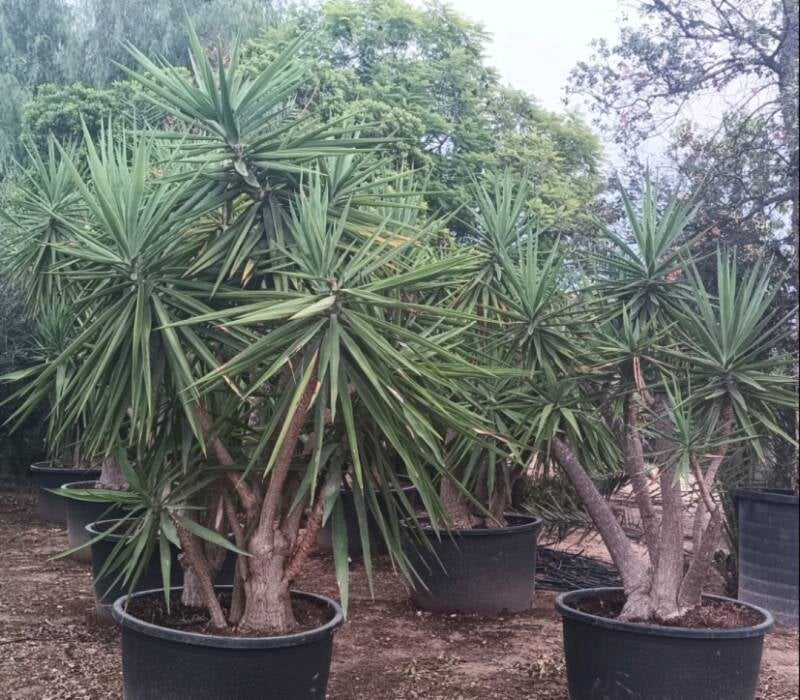
YUCCA ELEGANCE
¿WHAT IS A YUCCA ELEGANCE?
The Yucca Elegance is a perennial shrub suitable for both indoors and outdoors belonging to the Agavaceae family. Native to Central America, it can reach a height of 6 meters (though it typically stays between 2 and 4 meters when kept indoors) and is highly popular for its hardiness, distinctive foliage, and sculptural appearance. It is characterized by a robust, woody trunk topped with long, pointed, evergreen leaves that feature slightly sharp edges and a soft, muted green hue. It differs from Yucca elephantipes by being more branched and exhibiting slower, less vigorous growth.
¿WHAT IS A YUCCA ELEGANCE USED FOR?
It is highly prized in gardening and landscaping for its decorative appeal in indoor settings and its great resilience in both cold and warm climates. It is ideal for well-lit interiors or low-water gardens, and its striking architectural appearance makes it a distinctive feature of Mediterranean gardens.
¿WHAT CLIMATES CAN A YUCCA ELEGANCE WIHTSTAND?
It thrives in a Mediterranean or temperate climate with temperatures between 18°C and 28°C and can withstand temperatures up to 38°C without issues; however, above 41°C, its growth slows down and its leaves may suffer from scorching. It is drought-tolerant, as it stores water in its trunk and reduces transpiration through its leaves. It can withstand brief exposure to temperatures as low as -5°C or -8°C but does not tolerate extreme cold or prolonged frost, which can cause severe damage.
¿WHERE CAN I PLANT A YUCCA ELEGANCE?
In arid or sandy soil with excellent drainage; in locations with plenty of sunlight. If grown in partial shade, its growth will be slower, and its leaves will be weaker and more yellowish.
¿WHAT IS THE MAINTENANCE FOR A YUCCA ELEGANCE?
It requires watering once every 10–15 days in summer and once a month in winter. Excess water is the leading cause of death for the yucca, as it causes root rot. Sparse watering and high exposure to sunlight are the keys to its care. It is a low-maintenance plant.
YUCCA ROSTRATA
¿WHAT IS A YUCCA ROSTRATA?
Yucca rostrata, known as blue yucca or soyate, is a perennial shrub in the Asparagaceae family, native to the deserts of northern Mexico and the southern United States. It features slender, elongated, rigid, pointed leaves with a blue-gray hue. It can reach a height of 2 to 5 meters, forming a stunning, symmetrical, spherical crown atop a single trunk that often remains covered by a striking layer of dried leaves. In late spring or early summer, it produces large spikes bearing clusters of white flowers.
¿WHAT IS YUCCA ROSTRATA USED FOR?
It is very popular in the ornamental world, in xeriscaping, and for low-maintenance or aesthetic landscaping; it is used to decorate gravel gardens, rockeries, patios, and arid or Mediterranean areas, and serves as a focal point in outdoor design.
¿WHAT CLIMATES CAN YUCCA ROSTRATA WITHSTAND?
It is one of the hardiest yuccas, tolerating severe frosts and temperatures as low as -20°C in dry climates; in humid or coastal areas, it withstands temperatures down to -12°C, provided the soil is dry and well-drained. It thrives in arid and semi-arid climates, enduring scorching summers of 40°C to 50°C in its natural desert habitats, as well as long periods of drought due to its low water requirements.
¿WHERE CAN I PLANT YUCCA ROSTRATA?
It can be planted in full sun in well-drained sandy, rocky, or loamy soils to prevent waterlogging. It is perfect for pots on sunny terraces. Although it survives in humid areas, it is vital to protect it from excess water or persistent rain during the winter, as its roots can rot. It tolerates strong winds very well and can withstand salt spray without suffering serious damage.
¿WHAT IS THE MAINTENANCE FOR A YUCCA ROSTRATA?
If planted in a garden with a dry climate, watering once a month in summer is sufficient, with no watering required in winter. It needs a sandy or stony substrate that ensures good drainage. It is necessary to remove dry leaves attached to the trunk to improve its appearance and prevent pests.
